1947–1955
WB:
My gift is not miracles. My gift is to pray for the sick and the afflicted. It's healing, and not miracles. I'm awfully sorry that I ever did decide to perform a miracle before anyone; I am.
("Children In the Wilderness," November 23, 1947, message #47-1123)Comments:
What is William Branham (WB) saying here? He is saying he has a gift of healing but not a gift of miracles. If performing miracles wasn't God's gift to him, then how would he explain his ability to perform them? What kind of prophet seemingly has the power to perform miracles if God didn't give it to him? And if God didn't give it to him, from where did he get such a power? (Acts 8:9-24; 1 John 4:1)
WB:
And when the Angel of the Lord spoke to me, last time speaking . . . By the way, night before last, I seen him again in the room for the first time for about six months. And... But He never spoke to me. He was just standing by the door looking at me when I turned around. Kinda quickly, I fell on my face. But when I raised up, he was gone again.
("Children In the Wilderness," November 23, 1947, message #47-1123)Comments:
This is an interesting comment William Branham made in passing while talking about about another previous visit by his angel. Why did the angel appear to him for the first time in 6 months with nothing to say? Why did the angel leave as suddenly as it came, having given no reason for his visit? Was "the prophet" hallucinating? Was it just a dream he had while he was in his room alone? If he were a true prophet of God, what would God's purpose be for sending this angel to him just to look at him and then disappear? Only WB knew for sure—or maybe he didn't! How do we know he didn't make the whole thing up as he has at other times? Or worse, how do we know this unidentified angel who continued to visit him throughout his entire life wasn't the "Angel of Light" himself? (2 Corinthians 11:12-15) We should not be quick to take what WB said about anything on his word alone. Remember, Jesus told us to beware! Test the spirits!
WB:
But the last time he [the angel] spoke with me, he told me what I have been... told you last week. At Vandalia, Illinois, why, he told me I was confining too much of the work to working miracles. And it would come to pass that people would not believe me unless there was miracles performed. And that is true. It's got that way.
("Children In the Wilderness," November 23, 1947, message #47-1123)Comments:
This quote is from the same sermon as the previous two. Notice that his angel told him he was "confining too much of the work to working miracles." If, as we saw in one of his previous quotes, William Branham's gift was not to perform miracles, then why didn't the angel just tell him he should not even be performing miracles at all? But on the other hand, WB often said that his angel told him, "If you get the people to believe you, would be sincere when you pray, nothing shall stand before your prayer, not even to cancer." Why would the angel tell him to get people to believe him, then say not to use so many miracles to get people to believe him?Back to the point, we should be asking ourselves, "If performing miracles wasn't his gift, who was giving him this power to perform them in the first place?" Finding the answer to that is the responsibility of every believer of Jesus Christ when someone tells us to listen to him as "God's prophet."
WB:
Have you noticed, always, after I ask or rebuke over a spirit, I'm always perfectly silent for a few moments? Who's noticed that in the meetings, let's see your hands. Have you noticed that? Now, here's what it is. There's three words that I have to repeat at that time. See? And it's the three high words of the Bible. No mortal on earth know it. See? And when I ask that, and then I feel that drop, then it comes shakes back to a place in return of that spirit. Then the person's healed. That's the reason you hear me say that. See? That's what takes place. Now, I did that so you wouldn't be questioning me about it coming through the line. So that is true. Now, I know that you noticed a lot of times when I ask to rebuke, I stand still just for a few minutes and repeat these three words that the Angel of the Lord told me to repeat. Then if I feel it come back, then I know it's done.
("Experiences," March 2, 1948, message #48-0302)Comments:
Three high words of the Bible. What are they? Nobody knows except William Branham. But they're in the Bible, he said. So if they're in the Bible, how is it that nobody knows them? Why did his angel tell him to repeat these words whenever he was to rebuke a spirit? He says that somehow these special words invoke some sort of feeling in him that let's him know when someone has been healed. This is the only time WB mentions this incantation of sorts as far I could find. He never mentioned it again in any of his recorded sermons. But this type of thing is totally absent in the Bible. Certainly Jesus never spoke any mysterious words before He healed someone. None of the Apostles did. This kind of thing seems more in keeping with the occult. WB's "three high words" should be a red flag warning to anyone who believes in the Bible as God's revealed Word.
WB:
Angel of God, I do not see you. But I know that you are standing near. Please, thou knowest my heart, and know how I love these people. Stand by me tonight. And may not one go through without faith. And I know that your Words have been true. I've took you at your Word, for you said you were sent from God. I believed you. And you've stuck by me. You have confirmed the Word with signs following. Now, again tonight, in this March the fifth, this Memorial night, may you stand now and heal every one. Grant it.
("At Thy Word, Lord," March 5, 1948, message #48-0305)Comments:
Here we see William Branham actually praying to his angel. Does the Bible ever instruct us to pray to anyone but God? The Bible says that there is one intercessor between God and men, the man Christ Jesus (1 Timothy 2:5). There is nothing that WB prayed to his angel that he could not have asked God if he were a true believer. In fact, he even asked his angel to heal everyone! Why would he ask his angel and not God? WB got dangerously close (if not stepping over the line) to worshiping his angel.Let no one disqualify you, insisting on ascetic practices and the worship of angels, claiming access to a visionary realm and inflated without cause by his unspiritual mind. (Colossians 2:18).
WB:
He [the angel] said, "I'll be with you." And said, "That you might know, it'll come to pass that you'll take people by the right hand in your left." And said, "You'll feel the results of it (Now, I call it vibrations.) upon your hand. You'll become familiar with that. And you'll tell people all of their diseases, and what they've got in their body. And then if you'll be..."
Now, when I was in Texas the other time, that was in operation. Is that right? Any of you was in my meeting before, raise your hand if that was in operation? And if this... Now, you people raise your hands, all that was in my meeting, and know that was in operation. Not perfect, because I—I guessed at the diseases a whole lot. See? Because I didn't know how it felt.
I'd feel a funny feeling; sometimes female trouble and cancer. I couldn't detect it; it sounds so much alike, was—felt so much alike.
("Moses' Commission," January 10, 1950, message #50-0110)Comments:
William Branham is talking here about the gift the angel gave him to identify diseases people had by taking their hand and feeling the "vibrations" of the diseases in his own hand. The Bible says, "Every good gift and every perfect gift is from above, coming down from the Father of lights, with whom there is no variation or shadow due to change" (James 1:17). This gift of his, as well as his "gift of discernment," were not perfect. He said he would often guess at the diseases he was supposedly discerning. And as we know from several sermons of his, he sometimes guessed wrong. That is not good. WB's "gift" was not a good and perfect gift. Where in the Bible do we ever see Jesus or the Apostles or prophets from the Old Testament guessing at a Word from the Lord? The fact that WB's gift of discernment was imperfect is evidence that it was not of God. Rather, it seems to have been an ability given to him either by an imperfect source such as his mysterious "angel", or perhaps an invention of his own mind. In any case, this is not what we would expect from a true prophet of the Lord. In fact, it is what we would expect from a false prophet.(For examples of his imperfect gift, (click here and here)
WB:
So therefore, in order to obtain your healing, you'll have to become a Christian after you're healed. And I believe, I would say this, talking of the dual atonement, when you are healed, your sins are forgiven you. I didn't hear very many amens on that, but it's the truth.
("God In His People," February 27, 1950, message #50-0227)Comments:
Maybe William Branham didn't hear very many amens because what he said did not make any sense. He basically just said that to be healed, you have to get saved afterwards. But when you are healed, it shows you are saved. Would you say amen to that?What I think we see here is his attempt to promote his belief of a kind of dual atonement made by Jesus on the cross. This dual atonement (not to be confused with a similarly nick-named doctrine in Seventh-Day Adventism) stems from Isaiah's prophecy:
But he was wounded for our transgressions, he was bruised for our iniquities: the chastisement of our peace was upon him; and with his stripes we are healed.WB believed that when Jesus died on the cross for our sins, He also died for our physical healing, hence, the need for his healing campaigns. The problem is, in the context of Isaiah's prophecy (and repeated by Peter in 1 Peter 2:24) the healing they are both speaking of is our spiritual healing from sin. If WB's understanding of a dual atonement were true, then everyone who becomes born again would also be healed from all their physical diseases. That, of course, rarely happens. But that didn't keep people like WB and all the other so-called faith healers from drawing crowds to their meetings with their empty promises based on a misapplied Bible verse. Jesus' death on the cross was for the immediate forgiveness of sins for those who repent and believe the gospel and the consequent future healing when our perishable puts on imperishable, and our mortal bodies put on immortality when we are raised to everlasting life! (1 Corinthians 15:50-55)
(Isaiah 53:5)
WB:
There's no man can heal, not even Jesus. Jesus didn't claim to be a Divine Healer. He said, "It's not Me that doeth the works; It's My Father that dwelleth in Me; He doeth the works.
("Expectation," April 5, 1950, message #50-0405)See also:
Jesus didn't claim to do any healing. He said, "What the Father shows Me I don't do nothing. I can heal nothing, but just—I do just what the Father shows Me by vision; that's what I do." And you know that's the truth, isn't it? Every Bible reader, scholar knows that's the truth.
("Testimony," November 29, 1953, message #53-1129E)Comments:
Look up the following Bible passages in which Jesus Himself claimed to heal:Matthew 8:2-3; Matthew 8:7; Matthew 9:27-35; Mark 1:40-41; Luke 5:12-13; Luke 14:1-4These passages and many more indicate that Jesus healed people Himself:Matthew 4:23; Matthew 12:15-22; Matthew 21:14; Mark 3:10; Luke 5:15; Luke 13:14-15; Luke 22:50-51So why would William Branham be so adamant that Jesus the man could not heal? Because he did not believe Jesus Himself was truly God (Jesus According to William Branham). He believed that Jesus was a specially created man, made for God to indwell and work through.
WB actually misquoted Jesus when he said that Jesus claimed not to be able to heal. What Jesus said was, "Verily, verily, I say unto you, The Son can do nothing of himself, but what he seeth the Father do: for what things soever he doeth, these also doeth the Son likewise" (John 5:19). Jesus didn't say He couldn't heal. He said He doesn't do anything without the Father. What He sees the Father do, He does because Jesus is one with the Father (John 10:30).
WB did not understand who Jesus was. A true prophet of God could not contradict Jesus and the rest of the Scriptures as we see WB doing.
WB:
Somebody says, "How does Divine healing... Is it... Does it last all the time?" It lasts just as long as faith lasts. And salvation lasts the same way, just as long as faith lasts. When you feel that you're not saved anymore, you're not saved.
("Ministry Explained," July 11, 1950, message #50-0711)Comments:
William Branham made two very troubling statements here. The first has to do with his teaching that a person can lose their healing if their faith doesn't last. There is not one example in the Bible where Jesus or one of His disciples ever pronounced someone healed who later lost their healing because of any sort of lack of faith. This type of thing is how "faith healers" like WB leave themselves an out for when they pronounced someone healed but it later turned out that the person was never really healed at all. Sometimes WB has sent people away saying that their ailments may even get worse before they got better as the corrupted tissue dies in the person's body. This gives WB time to leave town before the person shows any sign of healing. For those who claimed their healing in one of WB's prayer lines but never received it, all WB had to do is say the person lost their faith and he bears no responsibility for what would otherwise identify him as a false prophet (see, And They Were All Healed Every One).Many people in the Bible were healed even when they had no faith, such as the centurian's servant (Matthew 8:5-13) and the man who was lowered though the roof of a house by his friends (Mark 2:1-12), or even the lame man at the gate of the temple (Acts 3:1-10). God's gifts are perfect and irrevocable (Romans 11:29, James 1:17).
His second troubling statement is even more disturbing. He said that salvation lasts only as long as someone "feels" that they're saved! If any discouraged Christian who has truly been born again has put their confidence in what WB said, how could they find any comfort that God is still their savior? Everyone goes through times of discouragement. Contrary to what WB said, Peter tells us,
Blessed be the God and Father of our Lord Jesus Christ, who according to His great mercy has caused us to be born again to a living hope through the resurrection of Jesus Christ from the dead, to obtain an inheritance which is imperishable, undefiled, and will not fade away, reserved in heaven for you, who are protected by the power of God through faith for a salvation ready to be revealed in the last time.We who have been born again by the precious blood of our Savior, Jesus Christ, can take comfort in knowing that God protects our salvation Himself through our times of distress and discouragement. Even if we feel we're not saved, we can run to Jesus and who guards our faith in Him!
(1 Peter 1:3-5)
WB:
But now, on the platform when someone meets me, then...it's not me that's speaking. When you hear my voice speaking when that inspiration is on, I have no more control of that than you know what you're going to say next New Year's day. I do not have no control of that, it speaks itself. It's my voice, and I'm listening to myself talk just as you're listening to me now talk. I hear myself, what it says to the people—Sometimes take a hold of their hand, I'll wait there, and after while I'll hear what it speaks, just hear myself speak, talking to the people. It's a very strange feeling. And under that anointing, being that my services are so close together, that it's best for me not to be too much under it at a time in one service.
("The Angel of the Lord," May 2, 1951, message #51-0502)Comments:
If it wasn't William Branham that was using his voice, who was it? He didn't say. But what we do know is that whoever it was, they sometimes "discerned" the person's name wrong, sometimes got their addresses wrong, and sometimes got the diseases wrong (see, Discernment Errors in Prayer Lines). So it couldn't have been God using his voice. Could his angel have been speaking through his voice? If it was, could his angel have been a lying spirit to test the people (1 Kings 22:22)? In any case, how could WB have been a prophet of the Lord when there was some sort of entity using his voice and making mistakes in discernment? If this was a test from the Lord, please don't fail the test! Don't follow a false prophet! Turn to Jesus, repent of your sins and believe the Gospel!
WB:
Now, I'm just your brother, by the grace of God. But when the Angel of the Lord moves down, It becomes then a Voice of God to you. Maybe it... If I offended you by saying that, forgive me. But I felt that might been resented. But I am God's Voice to you. See? I say that again. That time was under inspiration. See? And I—I felt bad about the first time, but It repeated it. Now see, I can say nothing in myself. But what He shows me, I say it. You believe it and watch what happens.
("My Commission," May 5, 1951, message #51-0505)Comments:
If there is any doubt that William Branham wanted his audiences to believe he was a prophet of the Lord, this statement should settle that question. But yet, he implied he wasn't under inspiration when he first said, "when the Angel of the Lord moves down, It becomes then a Voice of God to you." He then apologized for saying it if it offended them. Why would he apologize if it was the truth? Immediately afterwards, he said he was inspired to repeat it: "I am God's Voice to you."If you do a search, WB asked his audiences if they believed him "to be God's prophet" at least 220 times! That doesn't include the many times he said himself he was a prophet. On the other hand, he specifically said at least 4 times, "I never said I was a prophet." He even went on to say at least 10 times between 1955 and 1965, "I'm not a prophet." As if to validate such doublespeak, he quoted Amos more than once as saying, "I'm not a prophet nor a son of a prophet." But this is what the King James Version says: "Then answered Amos, and said to Amaziah, I was no prophet, neither was I a prophet's son; but I was an herdman, and a gatherer of sycomore fruit: And the Lord took me as I followed the flock, and the Lord said unto me, Go, prophesy unto my people Israel" (Amos 7:14-15).* WB misused a statement from a true prophet to justify speaking out of both sides of his mouth! In doing that, he actually left no doubt at all that he couldn't have been a true prophet of God. As Jesus told us, "Beware of false prophets who come to you in sheep's clothing..." Believe the Gospel!
__________
*The original Hebrew doesn't contain either "was" or "am" in v.14, and a minority of English translations do use the word, "am." The translators added either one or the other of these two words into the text according to which best favored the context. Those which use "was" do so because they believe the context is saying that Amos was not a prophet before God told him to prophesy to His people. Those who use "am" do so because they believe the context suggests that Amos was saying he was not a trained or professional prophet as Amaziah had implied he was in v. 12. WB's misuse of the quote is totally out of any possible context, because it makes Amos say that he was both a prophet and not a prophet—a logical impossibility. Besides, WB consistently used the King James Version in his studies. The KJV, as well as the majority of English translations, use the word, "was."
WB:
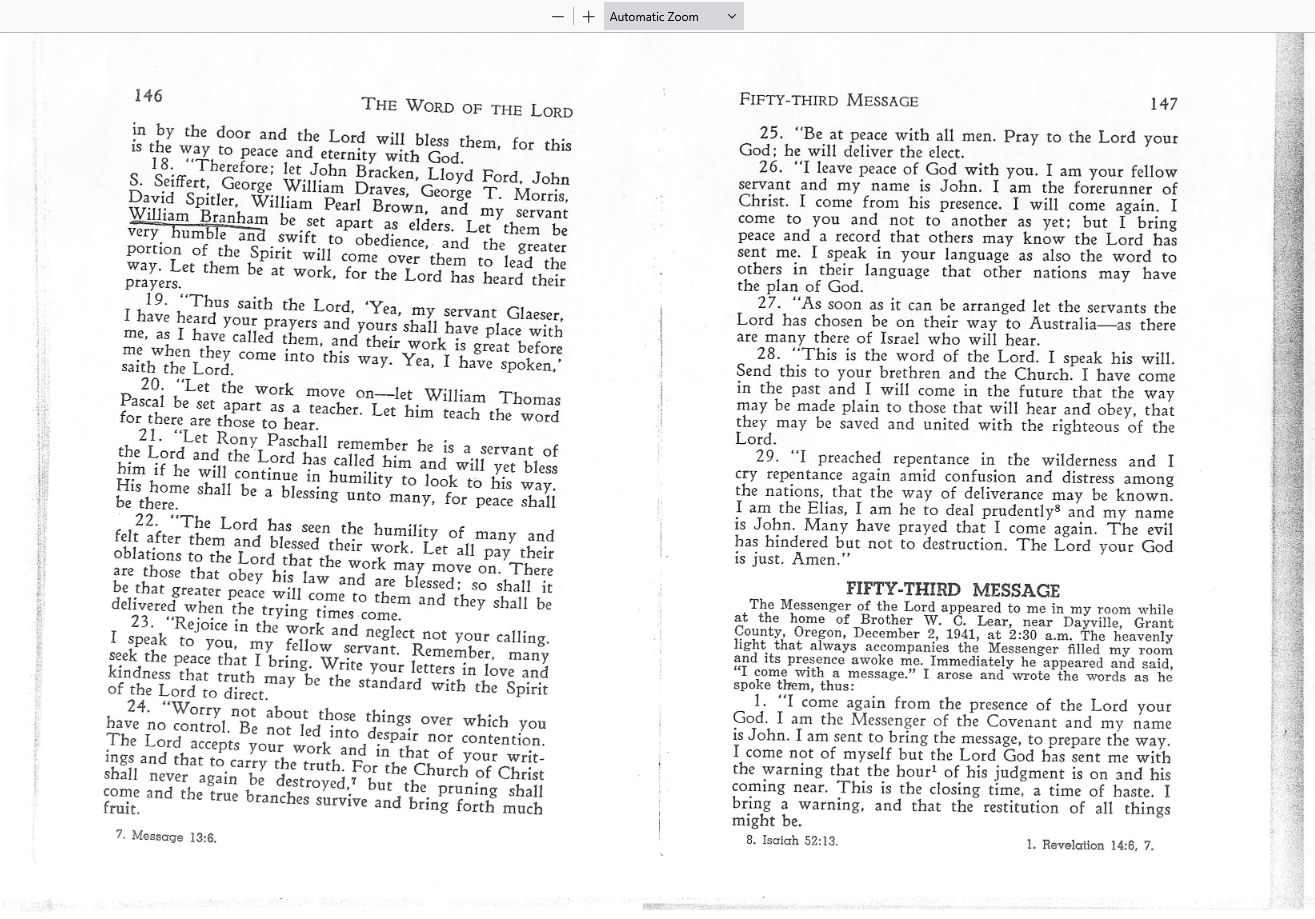
And then one night, I was coming out of Seattle, and there was a man standing over there. And he had a book under his arm. He kept telling me, "Brother Branham, you're in the wrong church." And I didn't know what he was talking of. And he put the book under my arm. It was called the Mormon Word Of God. I don't know what it was. It's a—it's one of their prophets of The Latter Day Saint, some bunch of them, that they claims they see the neophytes. And—and back there a hundred and...long long...how long ago it was, it...on a certain page there...I have the book in my library. It prophesied, their prophet, and said, that, "In the last days that Germany would have a—a ism called Nazis." And it went ahead and said, "In that day, let W-i double l-i-a-m, William Branham be called and set aside in humility for the service that I have called him to." That's right.
("Testimony," May 9, 1951, message #51-0509)Comments:
This book, called The Word of the Lord Brought to Mankind by an Angel, contains the alleged prophecy about William Branham. It was actually published by a small, break-away faction of the Latter Day Saint movement called the "Church of Christ with the Elijah Message." Contrary to what WB said, this book is not recognized as an official publication or scripture of the Church of Jesus Christ of Latter Day Saints (as if it would add any credibility to the "prophecy" if it were). The prophecy reads: "Therefore; let John Bracken, Lloyd Ford, John S. Seiffert, George William Draves, Geroge T. Morris, David Spitler, William Pearl Brown, and my servant William Branham be set apart as elders. Let them be very humble and swift to obedience, and the greater portion of the Spirit will come over them to lead the way. Let them be at work, for the Lord has heard their prayers."
This prophecy appears on page 146 of the book (to see a copy of this page, as well as the cover of the book itself,click here and here [offered a as free download from Tucson Tabernacle, accessed 5-2-26]). The list of names, which includes "William Branham," appear to be members of the local congregation who are being put forth as elders by the "Messenger of the Lord," who was an angel that often appeared to elder/apostle William Draves (see the Wikipedia article, "The Word of the Lord"). As you can see, the actual prophecy is quite different than WB's version as it appears in his quote.
WB seemed to think that the prophecy of himself was made around 100 years earlier. In reality, the book was a growing compilation of prophecies which started from February 4, 1927 to January 8, 1951 at the time WB preached this sermon (according to an online version of the book, the last prophecy was added on April 22, 1994). WB seemed impressed that the book had predicted Nazism so long ago. However, the book's only mention of Nazism was made on September 8th, 1939—seven days after Hitler started WWII by invading Poland! The actual prophecy that mentions WB's name was made on October 4, 1941, not even 10 years before this sermon was preached.
Think about this: If the William Branham mentioned in this Mormon prophecy was referring to William Branham from Jeffersonville, then why didn't he ever become an elder at the "Church of Christ with the Elijah Message" Church as predicted? Wouldn't that make the Mormon prediction a false prophecy? What WB attempted to claim as confirmation of his ministry would turn out to be the lie of another false prophet!
Comments:
To redeem them that were under the law, that we might receive the adoption of sons.
Having predestinated us unto the adoption of children by Jesus Christ to himself, according to the good pleasure of his will...
WB was terribly wrong. He was unbiblically wrong. When we are saved, we are conformed to the image of Jesus, not transformed into God's Divine essence. When He appears, we will be like Him (1 John 3:2), not part of His Being. We become one with God when we are in Christ, not when we become Deity. A true prophet of God would not and could not exalt man, who is a created being, into a "part" of God's uncreated Divinity!
Comments:
Among whom also we all had our conversation in times past in the lusts of our flesh, fulfilling the desires of the flesh and of the mind; and were by nature the children of wrath, even as others.
(Ephesians 2:3)
Wherefore, as by one man sin entered into the world, and death by sin; and so death passed upon all men, for that all have sinned...
(Romans 5:12)
Unto the pure all things are pure: but unto them that are defiled and unbelieving is nothing pure; but even their mind and conscience is defiled.
They profess that they know God; but in works they deny him, being abominable, and disobedient, and unto every good work reprobate.
(Titus 1:15-16)
Because the carnal mind is enmity against God: for it is not subject to the law of God, neither indeed can be.
So then they that are in the flesh cannot please God.
(Romans 8:7-8)
And you, that were sometime alienated and enemies in your mind by wicked works, yet now hath he reconciled
In the body of his flesh through death, to present you holy and unblameable and unreproveable in his sight.
(Colossians 1:22-23)
Every person is born in sin and shaped in iniquity (Psalm 51:5). That being so, how can anyone get saved? God draws them and opens their eyes to the gospel of Jesus (see John 6:37,44). When Paul says that "the god of this world" blinds they eyes of unbelievers (2 Corinthians 4:4), or that the devil captures people to do his will (2 Timothy 2:26), did he mean that the devil can keep someone from being saved against God's will to save them? No, unbelievers are blinded by Satan's influence because of their own lust for sin. They are held captive by the lies of the devil because they want to justify their sinful nature (Luke 10:29; 16:15). WB was wrong. No unregenerate person wants to do good for God. They want to do good because it makes them feel good in their sinful flesh, or their goodness assuages their guilt, or will somehow outweigh the bad they've done in order to stay on God's good side. But we who believe were saved in spite of our sinfulness: "But God demonstrates His own love toward us, in that while we were still sinners, Christ died for us. Much more then, having now been justified by His blood, we shall be saved from the wrath of God through Him." (Romans 5:7-9)
Without God, nobody would ever want to be good for His sake. It is only by God's grace that our eyes have been opened and we can see that the only good we can do is that which brings Him glory!
Comments:
The Angel of the Lord that comes is not the Lord Jesus. It doesn't look like Him in the same vision. For, the vision I saw of the Lord Jesus, He was a little Man.
Comments:
But his reason for identifying the zodiac as God's "first Bible" was based on his erronious view that the zodiac begins with Virgo and ends with Leo. The zodiac was invented by the Babylonians and refined by the Greeks and the Romans. They traditionally began the zodiac with the sign of Aries and ended it with Pisces. This puts Leo and Virgo side-by-side in the middle of the order of the signs of the zodiac. This removes the effect of WB's parable by placing Leo immediately before Virgo, not after Virgo at the complete end of the zodiac. What sense does it make to rearrange the zodiac to make it look more like the gospel when it has nothing to do with it, anyway?
God's "second Bible" is the Great Pyramid, which WB said Enoch built, and in which he placed his writing. What do we learn from this "Bible?" First, I can only surmise that Enoch's writing might be a reference to the apocalyptic Book of Enoch. WB's main idea, however, was that the the capstone is missing from the Great Pyramid, signifying "the cornerstone which the builders rejected." A major problem with this "Bible" is that Enoch could not have built the Great Pyramid since he left this earth before Noah's Flood, and the pyramids were built after the flood. Also, no writings attributed to Enoch have ever been found inside the Great Pyramid.
So why was he so enamored with the concept of "God's three Bibles?" It seems he wanted to use it as an illustration that God does "everything in threes." But why, since God doesn't do everything in threes (for example, the 10 plagues on Egypt, the 10 Commandments, choosing 12 tribes of Irael & 12 apostles, the "Seven Seals," etc., etc.). What kind of lesson is this supposed to teach the Church? Why should an end-time prophet spend so much time dwelling on faulty spiritual applications based on his misrepresentations of certain symbols and structures of ancient pagans? Don't learn lessons from them except for the lessons of what God does to those who worship idols and forsake His name! Turn from them and follow Christ!
Comments:
This idea is often called the pre-existence of souls. WB was influenced by many pseudo-Christian cults, such as Mormonism, the Jehovah's Witnesses, etc. He might have borrowed this view from the Mormons. They teach that human beings lived with God as spirits before they are later born into mortal bodies on earth. Once they are born, they lose all memories of their previous spirit-life. There is nothing in Scripture that teaches that we existed in spirit form before the 6 days of Creation. WB said Jesus said He knew us before the foundation of the world, which is false. God knew us by His foreknowledge, making His plans for us from before the foundation of the world. If knew and and chose us before the foundation of the world, that means we weren't created yet.
"I think that the people today that are possessed with this Spirit, or the spirit, a part of these angelic beings, spirits which rotated off of God, that never fell in the beginning and resisted the devil's lie in heaven."
It sounds as if he's saying that God created angelic beings which "rotated off of God" and entered into Spirit-filled people. Nowhere in the Bible can we find anything even close to this.
"And two thirds of the earth is in sin, and more than that, which two thirds of the angels was kicked out. And those demon spirits come into people and habitate their body. See what I mean? They're demons that once... They was once existed and they come into the people and give them a nature."
Here he seems to imply that the demons who fell have come down to inhabit the bodies of sinners, giving them a sinful nature. It is true that demons occasionally possess the bodies of individuals at various times, but that is not the cause of man's sinful nature. Sin is actually an attribute of humanity as a result of Fall (Romans 5:12-18).
"And then He put man in the dust of the earth, which was the first man Adam. And that man was made after the image, this human man here, is made after the image of an animal."
Never does the Bible ever say that man was made in the image of animals. The Bible does say that animals were created before Adam, and we do see certain physical similarities between human beings and animals, but that is not a reason to conclude God made man in the image of animals. Saying that adds to Scripture and demeans mankind who truly was a being made in the image of God. Even though God, being a Spirit, doesn't have a physical body of flesh and blood (John 4:24, Luke 24:39), the Bible still says, "Whoever sheds the blood of man, by man shall his blood be shed, for God made man in his own image (Genesis 9:6)."
" It's in the image of animal life, because he was made something on the order of the animal, because that was his duty to lead the animal."
Not only is that not taught in Scripture, but it doesn't even make any sense. Why would man have to look like an animal in order to lead it?
This quote from William Branham demonstrates that he not only didn't know the Bible, but he wasn't hesitant to add to it. Furthermore, what he knew of the Bible, he is shown to misquote and misinterpret it. These are not characteristics of a true prophet of the Lord. The opposite of a true prophet is a false prophet!
Comments:
Comments:
Later on when I was about three years old, I remember hearing a voice speak to me and tell me that I would live near a city called New Albany, and I live in three miles of New Albany.
My little brother waddled his way back to—towards the house; and he was as far as, oh, fifty yards from the house, perhaps. He'd went back to the house, and I was still playing around the little branch. I heard a bird setting up there, and the bird was chirping. And I listened at him, and he was whistling, might've been a robin, or something, a whistling, making a song. And then, coming down through there, came a Voice. Now, remember, friends, this Bible lays open before me when I say this. Now, whether it come from the bird, from the tree, I was just a laddie boy, and didn't know. I cannot say. God knows. I do not. But a Voice spoke to me, that I was going to live near a city called New Albany.
And from a little bitty—little small lad of about, I suppose, two years old, was the first time I remember of That speaking to me. And He told me I would live near a city called New Albany, Indiana.
When I was eighteen months old, I remember of a Voice speaking to me and telling me that was going to live near a city called New Albany.
And the next thing I remember was God speaking to me in a vision, and telling me that I'd spend a bigger part of my life near a city called New Albany.
Now, then I remember being at this little old spring, and I had a rock and was throwing it down like that, in the mud, trying to show my little brother how strong I was. And there was a bird sitting up in the tree and he was chirping, tearing around, a little old robin or something. And, the little robin, I thought he spoke to me. And I turned and listened, and the bird flew away, and a Voice said, "You're going to spend a big part of your life near a city called New Albany."
The first thing I can remember was the vision when I was born in the state of Kentucky, and told me I'd live in Indiana near a city called New Albany. I've lived in three year...three miles of it all my life. And I wasn't but eighteen months old when the vision came.
Visions, the first thing I remember as a little baby boy was a vision. I wasn't eighteen months old when I told my mother where we'd live at, and everything else. See? That's right. And spent my life near New Albany.
When I was just a little boy, I don't know how old, I was just still crawling, I must have been not over two years old, I remember the first thing I can remember is a vision, see, when I was just a little boy, and it told me that I was going to live in Indiana near a place called New Albany.
When I was about three or four, between three and four years old, He spoke to me, I was in the mountains of Kentucky, said, "You'll live near a city called New Albany."
Standing the other day, when I was down in Kentucky, just across a few hollers to where the Angel of the Lord came down, and said, "You're going to live near a city called New Albany."
I've saw visions since I was about eighteen months old. First vision I ever saw, I told my mother where we would live, and, near New Albany, Indiana, we was hundreds of miles away, we've lived there all my life.
And I can remember of hearing It when I was just a little boy, way down in the mountains of Kentucky. And I thought It was a bird sitting in a tree, but the bird flew away. He said, "Don't fear, 'cause you're going to leave from here some day, and live near a city called New Albany."
And then I remember one day the spring (this little cabin) was just behind the house. And—and during that time after...There's nine...eleven months difference between me and my next brother, and he was still crawling. And I had a big rock in my hand, and I was trying to show him how hard I could throw this rock in the old mud, where the spring had run out of the ground and made the muddy ground. And I heard a bird, and it was singing up in a tree. And I looked up to that tree and the bird flew away, and, when it did, a Voice spoke to me. Now, I know you think I could not think and remember that. But the Lord God Who's Judge, the earth and the heavens and all there is, knows that I'm telling the truth. That bird, when it flew away, a Voice came from where the bird was in the tree, like a wind caught in the bush, and It said, "You'll live near a city called New Albany." And I've lived, from the time I was three years old until this time, within three miles of New Albany, Indiana. I went in and told my mother about it. Well, she thought I was just dreaming or something.
When I was just about two years old, the first vision I ever remember seeing, I was playing in the backyard with my little brother, who could just crawl, and there was a Voice came from a bush and said, "You will live near a city called New Albany." It...I was very much frightened, and ran into the house to tell my mother. She didn't know what it meant.
First vision I ever seen was in a bush, and the—the Angel of the Lord was in there like a wind, and told me that I would live near a city called New Albany. And I was two years old, living in the mountains in Kentucky, and I've spent my life within three or four miles of New Albany, Indiana, two hundred, three hundred miles away.
And then the next thing I remember taking place in my life, was a vision, the first one I ever had, and told me I would live a big portion of my life near a city called New Albany. And I was a little mountain baby up there, not even a doctor when I was born. And—and I—I...You know, they...I've lived here around fifty years, right here; a vision.
Comments:
Some of WB's views of Jesus seem to have been borrowed from the Jehovah's Witnesses' teachings. For example, he believed, as they do, that Michael the Archangel was Jesus Christ. And of course, both Branham and the Jehovah's Witnesses were strongly anti–Trinitarian. Could these similarities have been so important to WB that he felt it best not to speak against them? Or maybe he thought he shouldn't speak against another theologically unorthodox sect. His response to the questioner is strange, coming from a prophet who was supposed to restore biblical integrity. This is another warning sign that the Church needs to be attentive to!
Comments:
The Bible never calls Jesus a sinner. It would be blasphemous to say such a thing since that would make God a sinner. The Bible says just the opposite. Hebrews 4:15 says, "For we do not have a high priest who cannot sympathize with our weaknesses, but One who has been tempted in all things just as we are, yet without sin." So what would lead Wm. Branham to say that Jesus was a sinner? Did he think that Jesus actually sinned? Here is the verse WB probably got the idea from:
When we read in the Bible that God made Jesus to be sin for us, it is by no means saying that Jesus was a sinner. What is a sinner? Well, just as a liar is someone who lies, and a thief is a person who steals, so a sinner is someone who sins. But Jesus never sinned, so He could not have been a sinner. What the Bible says is that He was made sin for us. He didn't become a sinner. He took our sins upon Himself so that He could be a sin offering to atone for and remove all the sins of those who would believe in Him. There is a passage in Leviticus 16 which describes what Aaron did to atone for the sins of the people. This is a picture of what Jesus did. He became a sin offering, that is, the sacrifice for sin in which the first goat is slain. But He also becomes the "scapegoat," which is the goat on which the sins of the people were placed so the goat could carry their sins way out into the wilderness. It is in this way that Jesus became sin for us--taking our sins on Him so that once He was sacrificed for our sins and raised from the dead, our sins would be taken far from us. But where the blood of bulls and goats could never permanently take away sin, Jesus' work of being the sin offering and scapegoat both atoned for our sins and removed our sins for all eternity! Jesus was not a sinner, but a sin bearer and sin destroyer! Praise God for sending His sinless Son to save us from our sins!
One more point before we finish. WB said in both the above quotes that God in the form of Jesus became a sinner that we sinners might become God! He was obviously confused on this since he couldn't make up his mind how to say it:
"The innocent Lamb of God Who knowed no sin, became a sinner, that I might be made adopted son of God."
"God became man, that man might became God, become God."
"He become me, that I might become Him."
"He become a sinner, that I might become a son of God."
"He become a sinner, that you might become a son of God." Each one of those statements contain some form of blasphemy and/or heresy. He said that Jesus was a sinner and that we become God. The Bible never says that we could ever become Him. We become one in Him (see John 14:20 and 17:20), but as creatures, we could never become the Creator. The Bible does say that He makes believers of Jesus into sons of God, and goes on to say that our sonship is by adoption (see Galatians 4:5).
We could understand a new believer making mistakes like these, but as he grows, he will be corrected and discard those unbiblical notions. But William Branham never did. He continued to teach them without correction or repentance. What's more, he claimed to teach those errors on God's behalf as a so-called "Word prophet"!
Comments:
WB:
And if we
become in spirit sons of God, Deity dwells in the man. Hallelujah! Then
you talk about blind eyes being open.
They said nothing impossible to
God. God said nothing impossible with you, if you'll believe, not with
God, but you. Deity's in man.
The very God that stood back there on
the mythical platform of the eternities, and rolled worlds off of His hands,
and created these things give you the privilege to be His son, and you're a
part of Him. And God dwells in mankind, and man himself is Deity.
Hallelujah! There you are. It might choke you, but study over that
a little while.
("Resurrection of Lazarus," July 29, 1951, message #51-0729A)
Let's take a look at what WB just said:
And God dwells in mankind, and man himself is Deity.
Another time he said:
When you receive the Holy Ghost, then you become eternal, because you have—you're with God, you're part of God. Can you see what I mean? You are as eternal as God is...
("Questions And Answers," message #59-1223)
WB often defined eternal as having no beginning or end, and said that "God alone is eternal" (the biblical quality of what is "eternal" does not require that something had no beginning, but only that it has no end). He believed that man can become God by virtue of God making Himself part of a created being, namely a believer in Christ! He confused the Creator/creation distinction. God cannot make a created being a part of Deity (not to be confused with the Incarnation, which was a single Being of Deity made flesh from the moment of Jesus' conception). The Bible does not call us "spirit sons of God" as WB did in this quote. The Bible says we become adopted sons of God:
For ye have not received the spirit of bondage again to fear; but ye have received the Spirit of adoption, whereby we cry, Abba, Father.
(Romans 8:15)
(Galatians 4:5)
(Ephesians 1:5)
When a person repents and believes in Jesus Christ for the forgiveness of sins, they are at that moment born again and filled with God's Spirit (Romans 8:9). When God saves us and puts His Spirit in us, we don't become Him. We are still creations of His. But He makes us sons and daughters through adoption, making us brothers and sisters of Jesus Christ (Romans 8:29)—sons of God (Romans 8:14,19).
WB:
And the only thing that kept me from being saved when I was twelve years old, because a spirit hung over me, a devil, saying, "Wait a little while longer." That's the reason you wasn't saved when you become the age of accountability. A spirit, you got in a crowd, and that hovered over you and kept hanging over you. You wanted to do right. There's not a man that's got his right mind but what wants to do right, but there is something won't let you do right. Is that right? That's the devil.
("Believing God," February 24, 1952, message #52-0224)
WB seems to have thought that people naturally have a desire to do good and would gladly respond in faith to the gospel if the devil would only let them. However, that's not the view of human nature according to the Bible:
As it is written, There is none righteous, no, not one:
There is none that understandeth, there is none that seeketh after God.
They are all gone out of the way, they are together become unprofitable; there is none that doeth good, no, not one.
Their throat is an open sepulchre; with their tongues they have used deceit; the poison of asps is under their lips:
Whose mouth is full of cursing and bitterness:
Their feet are swift to shed blood:
Destruction and misery are in their ways:
And the way of peace have they not known:
There is no fear of God before their eyes.
(Romans 3:10-18)
WB:
Now, sir, you are a stranger to me. I don't believe I know you. If I've ever met you, I don't remember. This is our first meeting. If that's... that's right, isn't it? It's our first meeting. Then you're altogether a stranger. Does anybody here know this man? All right. Someone knows him then. And you know the man to be an honest man. I suppose he is. He—he's a Christian; I know that. For his spirit bears record with this Angel that has me anointed now, this—this powerful One that comes from the Presence of God, that's on my mortal body now.
("Jesus Christ The Same Yesterday, And Today, And Forever," August 10, 1952, message #52-0810E)
That is an unusual choice of words. Where in the Bible do we ever read that an angel has ever anointed someone, or somehow came upon a person's mortal body? There have been plenty of times that the "Spirit of the Lord" was on someone who was anointed to speak on God's behalf. But an angel? The only time we see language like that being used by someone other than the Lord is when fallen angels came and possessed or took control of a person's body. In fact, WB has even said this angel would sometimes speak through him:
Now remember, I am not the gift. The one that you'll see in performance here tonight, which is here visibly—invisibly now, He's the gift. He's the One that God sent down. I just speak when He speaks through me. I can say nothing unless He says it to me first.
("Obey the Voice of the Angel," message #50-0713)
We never see things like this happening by an angel from God. WB's angel* would sometimes mysteriously appear and disappear before him for no reason at all, as we've previously discussed. Why? What reason do we have to believe WB's angel was from God and not the enemy? Why are there so many warning signs surrounding this angel's visitations? Why did WB make so many errors of discernment if the angel that led him in his meetings was from God? How many warning signs does God have to give us before we see that WB was a false prophet who claimed to be led and often controlled by an entity that, on biblical grounds, could not have been an angel from the Lord? Always remember the Apostle Paul's exhortation:
And no marvel; for Satan himself is transformed into an angel of light.
Therefore it is no great thing if his ministers also be transformed as the ministers of righteousness; whose end shall be according to their works.
(1 Corinthians 11:14,15)
Or the Apostle John, who wrote:
Beloved, believe not every spirit, but try the spirits whether they are of God: because many false prophets are gone out into the world.
(1 John 4:1)
We have God's Word to lead and guide us into what is true. We have no excuse for falling for the deceptions of the enemy when we give him the benefit of the doubt!
________________
*Some have wondered if WB's "Angel of the Lord" might have been God or Jesus. WB himself debunked that possibility:
[H]ere's what the Angel of the Lord, the first thing He said to me, "I am sent from the Presence of God, of Almighty God . . ."
("Three Witnesses," message #51-0728)
("How The Angel Came To Me, And His Commission," message #55-0117)
WB:
What's He doing? He's writing His first Bible.
The first Bible was ever written, was written in the skies, the zodiac. It
starts out with the virgin; that's how He come first. It ends up with Leo the
lion, the second coming. And He's writing His first Bible. The second Bible
was written, was written by Enoch, and put in the pyramid.
The third Bible
was written, and the last one, is this One. [Brother
Branham indicates his Bible—Ed.]
God always does things in threes.
God is perfect in three. He's perfect. [Brother Branham
clears his throat—Ed.] Pardon me. He's perfect in Father, Son, Holy
Spirit. He's perfect in justification, sanctification, baptism of the Holy
Spirit. He's perfected in His threes.
("The Cruelty of Sin, and the Penalty it Cost to Rid Sin
From Our Lives," April 3, 1953, message #53-0403)
WB talked about the "three Bibles" many times between around 1950 and 1964. Although he had said a couple of times that he did't promote the zodiac or pyramidology as part of his teachings, he liked to use this "parable" (as he called it) a lot. He thought it was important that the zodiac began with Virgo (the virgin), and ended with Leo, the lion. He believed this corresponded to the gospel, which began with the virgin birth and ends with the second coming of Christ as the "lion" of the tribe of Judah.
WB:
Now, the first man, now, He made the first man in His image, and we're returning back to that image (That's right.), to our first created image.
When God created me, William Branham, I was before the foundation of the world; He made my being, my spirit. I wasn't conscious of anything as far as I know of, but the... I was there. Oh, I—I don't believe you're getting it. But now, just a minute, Jesus told the disciples that He knew them before the foundation of the world; and Paul said here that He chose us in Him before the world began. Now, there was some part of me, Orman Neville, and the rest of you all here, that's in Christ Jesus before the world ever began. And here's to my analysis of that.
I think that the people today that are possessed with this Spirit, or the spirit, a part of these angelic beings, spirits which rotated off of God, that never fell in the beginning and resisted the devil's lie in heaven...
And two thirds of the earth is in sin, and more than that, which two thirds of the angels was kicked out. And those demon spirits come into people and habitate their body. See what I mean? They're demons that once... They was once existed and they come into the people and give them a nature. Jesus cast seven of them out of Mary Magdalene: Pride, boast (big people, you see?), unclean, filthy, vulgarity, emulations, strife, all these things. See?
Them was spirits that was made up back there when God began to make man off of there in His Own image, created those supernatural beings, those spirits...
And then He put man in the dust of the earth, which was the first man Adam. And that man was made after the image, this human man here, is made after the image of an animal. These human bodies are made in the image of animal.
We got a hand just like a monkey, and—and got a foot like a bear. Take a little cub bear, strip him down, pull the skin off of him and put up the side of a little baby girl and look at the difference. Huh. Brother, you sure have to look close. The whole diaphragm, the make-up, is almost the same, the way it's made and the form of it, and everything just exactly. It's in the image of animal life, because he was made something on the order of the animal, because that was his duty to lead the animal.
("Questions and Answers on Genesis)," July 29, 1953, message #53-0729)
There is a lot of false teaching in this quote. Let's go through this one at a time.
"When God created me, William Branham, I was before the foundation of the world; He made my being, my spirit. I wasn't conscious of anything as far as I know of, but the... I was there."
WB:
Now, God made Eve from Adam's side. The woman has one more rib today in the anatomy, the make-up than man does, because a rib was taken from Adam's body.
("Questions and Answers on Genesis," July 29, 1953, message #53-0729)
That is patently false. Both men and women have 12 pairs of ribs, making a total of 24 ribs. As far as we know, God never replaced the rib He took from Adam to make Eve from, so he probably had one less rib than Eve. Nevertheless, there is nothing in the Bible that says all men have one less rib than women because of Adam, so why would WB say that? This is another example of a supposed prophet giving occasion for unbelievers to mock God, not because of what God said, but because of an easily misproven myth that a "prophet" believed and taught his followers in public! As followers of Jesus Christ, let us be careful to present oursevles to the world in wisdom so as not to cause the name of God and His Word to be blasphemed (see 1 Timothy 6:1).
WB:
At about fifteen, eighteen months old I had my first vision. I was standing near a little branch and something spoke to me from the bush and said you're going to live near a city called New Albany. I've spent my life there.
("Deep Calleth Unto the Deep," November 4, 1953, message #53-1104)
I didn't realize while I was in the Message how many times WB recounted his very first vision. Which one do you suppose was true?
Which version do you think most Message believers share with others when witnessing about their prophet?
("Exhortation Of Divine Healing," May 1, 1951, message #51-0501)
("Early Spiritual Experiences," July 13, 1952, message #52-0713A)
("Palmerworm, Locust, Cankerworm, Caterpillar," June 12, 1953, message #53-0612)
("Do You Now Believe?," December 6, 1953, message #53-1206E)
("God's Provided Way Of Healing," July 19, 1954, message #54-0719A)
("How The Angel Came To Me, And His Commission," January 17, 1955, message #55-0117)
("Abraham," June 8, 1955, message #55-0608)
("The Darkest Hour, Then Jesus Comes Along," November 14, 1955, message #55-1114)
("The Infallible Proof Of The Resurrection," January 14, 1957, message #57-0114)
("Expectations And Leadings Of The Spirit," August 11, 1957, message #57-0811E)
("Jesus Christ The Same Yesterday, Today, And Forever," September 22, 1957, message #57-0922M)
("Door To The Heart," March 16, 1958, message #58-0316E)
("Hear His Voice," October 5, 1958, message #58-1005M)
("My Life Story," April 19, 1959, message #59-0419A)
("The Revelation That Was Given To Me," February 10, 1960, message #60-0210M)
("Abraham," August 3, 1960, message #60-0803)
("Souls That Are In Prison Now," November 10, 1963, message #63-1110M)
WB:
Now, here was another one who said... I'd... I—I appreciate this asking. And Almighty God Who is my Judge, standing here now in this sacred spot... Before I left home, the Spirit of the Lord told me, said this question will be laying on here. And I—I knowed nothing about it, but I knew it would be here.
"Is Jehovah Witness a false sect?"
See, somebody... And the Holy Spirit, at the place at the... Standing in my bathroom before coming down here, God, Who is my solemn Judge, told me, "That will be laying on the platform," and said I wouldn't say nothing about it, just go on. See? So I... You know what I said last night, don't you? All right, that's what it was.
("QA, Image of the Beast," May 15, 1954, message #54-0515)
Why would God not allow William Branham to say anything about the Jehovah's Witnesses when he was always so strong in condemning theologically orthodox Christian denominations? As far as I could find, he never spoke a critical word about them, even when they spoke against him (once someone told him that the JWs say he's a false prophet. His response was, "'Well, they got their right to say whatever they want to,' I said, 'but I want to know what God says about it.'" ["We Would See Jesus," message #57-0516]).
We know he liked to use their Greek-to-English interlinear New Testament by Benjamin Wilson, called The Emphatic Diaglott. Wilson was a Christadelphian; a sect which was a precursor to the Jehovah's Witnesses. The JWs used to print and refer to it as their exclusive study tool, but they no longer use it now that they have the Kingdom Interlinear Translation of the Greek Scriptures, and their own Bible, The New World Translation. WB held the Diaglott in high regard; perhaps because its renderings sometimes appear to favor anti-Trinitarianism. For example, in the Diaglott's word-for-word translation of John 1:1, the text reads: "In a beginning was the Word, and the Word was with the God, and a god was the Word."
WB:
Now, that's a miracle. Usually when the growth is dead, the life goes out of it. But the growth... If it can't drop off, it's on the inside. And if it does, of course, it'll lay there for a few days and begin to swell up. Like any other flesh, the cells will begin to break. Then you get real sick with a fever. 'Course, it's an infection. Like the heart pumps the blood and purifies the body. There's a big lump of flesh laying loose in your body. The patient gets violently sick. Then you say, "Oh, I—I felt so good on—on the platform and for a day or two. But I guess I've lost my healing."
Why, brother, sister, that's the best sign in the world you've got your healing. See? And then you start disbelieving, and just as sure as your faith taken the life away, your unbelief will bring it back again. See? It will, it'll resurrect it. Remember, Jesus said, "When they unclean spirit went out of a man, he walks in dry places. Then he returns with seven other spirits."
("The Deep Calleth to the Deep," June 24, 1954, message #54-0624)
WB:
"And
at that time Michael shall stand, the great prince." Michael was Christ, of
course, Who fought the angelic wars in heaven with the devil. Satan and
Michael fought together, or fought against each other,
rather.
("Beginning and Ending of the Gentile Dispensation," January 9, 1955, message #55-0109E)
WB:
I said, "Brother
Best [a critic of William Branham's], I only tell what's truth. And if I'm truthful, God's obligated to
back up the truth." I said, "If He isn't... If He won't back up the
truth, then He isn't God." And I said, "I do not heal people. I
was born with a—with a gift to see things, see it happen." I said, "I
know I'm misunderstood, but I can do no more than fulfill the conviction of my
heart." I said, "I believe that Jesus Christ raised from the dead.
And if the Spirit that comes and shows visions and so forth, if that's
questioned, drop around and find out." I said, "That's all." But I
said, "But for myself, I can do nothing of my own self." And I said, "If
I tell the truth, God's obligated to me, to witness that It is the
truth."
("How the Angel Came to Me, And His Commission," January 17, 1955, message #55-0117)
WB:
When God became a sinner, taking our sins. Jesus became me, that I might become Him. The innocent Lamb of God Who knowed no sin, became a sinner, that I might be made adopted son of God.
("Job," February 23, 1955, message #55-0223)
WB said that in 1955. He said something very similar 5 years later in 1960:
So, God became man, that man might became God, become God. Amen. We, being men, sinners, God became a sinner, took our sins upon Him. Knowing no sins, yet was a sinner because our sins was placed upon Him. That we...He become me, that I might become Him. See? He become a sinner, that I might become a son of God. He become a sinner, that you might become a son of God.
("The Kinsman Redeemer," message #60-1002)For he hath made him to be sin for us, who knew no sin; that we might be made the righteousness of God in him. (2 Corinthians 5:21)
WB concluded that Jesus actually became a sinner, making the same mistake some immature Christians make when they read this verse. Yet he considered himself a major prophet of God!
"Jesus became me, that I might become Him."
WB:
And when Jesus, a carpenter's Son, physically speaking, when He come to the earth here that's all He was known of, and the day that when John baptized Him, God a vindicated Him. God spoke from the heavens. John saw Him coming in the form a dove, and said, "This is My beloved Son in Whom I'm pleased to dwell." The right translation there is, "In whom I am pleased to dwell in." [William Branham got it wrong on both counts. The actual verse says, "This is my beloved Son, in whom I am well pleased."] Jesus immediately anointed with God, He was just a man till that time, but now He becomes the God-man.
(Jesus Christ the Same Yesterday, Today and Forever, August 6, 1955, message #55-0806)
WB:
Now, it isn't me. You say, "Brother Branham, can you tell me
what's wrong with me?" No, sir, I cannot. That's right. But
if—if you will believe it with all your heart, now, not imagine it, but
believe it with your heart, God will tell you about it. But now, I don't
know what I'm saying. I can hear myself, but I'm in another
world—another... It's a—it's a sixth sense, or a fourth dimension, it's—or
whatever it is.
("Come, Let Us Reason Together," October 4, 1955, message #55-1004)
See commentary at QB47.10