Back to Fiction and Non
Traditional Costumes of the State of Mexico
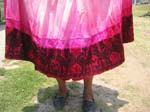
The typical "Indian" costume of the State of Mexico, of which Toluca is the capital, is a mix including elements of the Otomí and of the Mazahua traditions. Women dress in a brightly-coloured blouse (vibrant pink is much favoured) in a satiny material, a rebozo and/or a quechemetl. (Also spelled variously as quechemitl, quexquemetl, quechquemitl or quesquemetl.) The rebozo is typically navy blue, or black, with narrow blue or red stripes. The quechemetl can be plain wool or cotton, but is often embroidered in floral and animal motifs. Mazahua women wear a billowy satin skirt over multiple cotton underskirts, down to mid-calf, also in bright colours. Otomi women, one of which was Lupe's Nana, wear a wide hand-loomed circle of navy or black wool, which includes horizontal narrow lines of yellow, green, or red every few inches. It is folded in pleats to fit, and fastened on with a bright belt, or "faja" of hand-woven wool, wrapped around the middle many times. The skirt is usually about ankle length. Shoes are huaraches, or more recently, cheap low-heeled plastic shoes. Men used to wear cotton pants and blouse, but now usually wear modern pants and shirts. Over this, they wear a gaban, a blanket-like covering, with a slit for the head. These are hand woven, and each village has its own distinctive pattern and colours. Huaraches are common foot attire; both men and women may wear a straw hat. History of the QuechemetlThe quechemetl has been worn by women of Central Mexico for centuries. They have appeared on ancient codices, worn by deities such as Mayahuel, the goddess of pulque, and Chicomecoatl, the corn goddess. Before the conquest, their use was limited to priestesses, and was worn alone or with a huipil underneath. For each village and tribal heritage, there is a slight difference in the style of embroidery and manner of wearing the quechemetl. The ones from the colder areas, such as in the vicinity of Toluca, tend to be heavier and longer, made of wool instead of the cotton of warmer areas. Previously, the dyes were of naturally occurring plants and insects. In recent years, commercial dyes have supplanted them, making possible a variety of colours not seen in older pieces. Traditional colours are usually a variety of strong reds, navy blues and blacks, and in some areas, the natural browns and blacks of the wool. The Mazahuas preferred the reds above all other colours. The natural dye is not colour-fast, but this was considered an advantage; with time, the red wool tints the white cotton background, softening the harsh contrast of shades, blurring the images. |
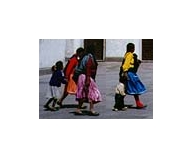 
Scenes from Toluca streets: Mazahua women, the gabán |
Following are some links to websites which include photos of quechemetls, including some worn by Aztec deities.
Pantepec  |
©Susannah Anderson, 1999
top